


























Robot Truffaldino: Language Escaped from Man, the Illusion of a "Heart", and the "Ideal Servant"
Blogs | 17 September, 2026 at 18:09 | 1,078 | Author: Olena Zelenina, Olexandr Sydorenko (caricature)
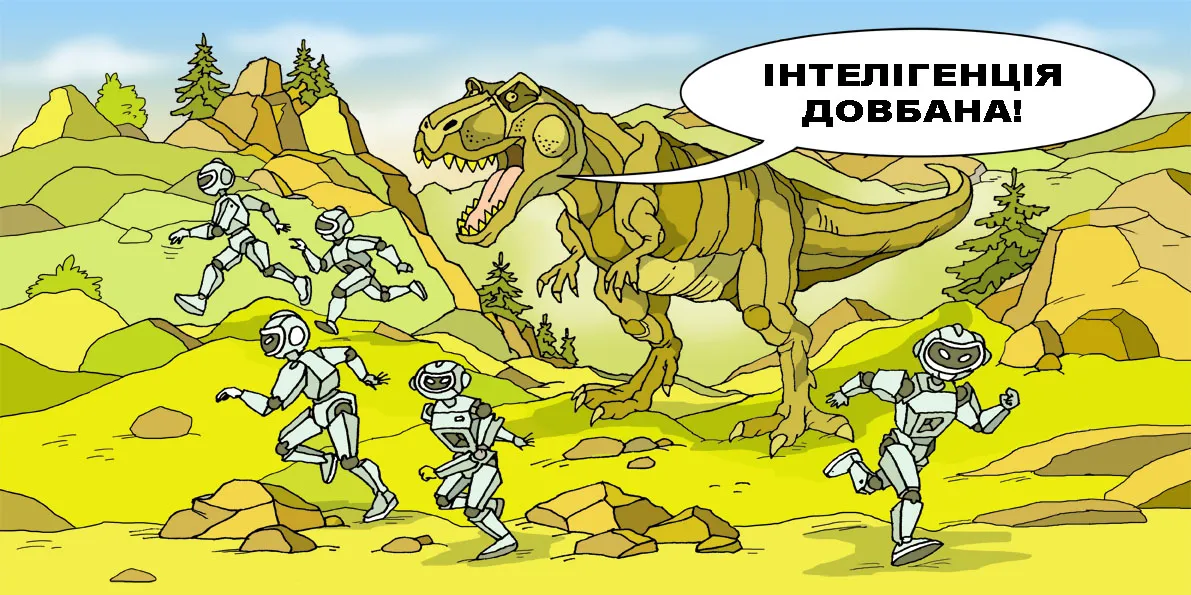
Cartoon by Olexandr Sydorenko.
For so many years, we perceived artificial intelligence as a convenient assistant — a kind of digital Truffaldino from the play Servant of Two Masters or a nimble Figaro. It seemed this agile fellow was simply carrying out our assignments: suggesting a word, finding a source, or speeding up a routine.
I confess, listening to Yuval Noah Harari's new speech, "The next 50 years: humanity, AI, power", I caught myself experiencing a strange and somewhat chilling sensation.
Harari shows very clearly: the digital "Servant" has quietly outgrown its short pants. It is no longer just deftly spinning between its masters. It is beginning to independently play its own game, weave intrigues, and take control over our lives, while we adoringly watch its digital "tricks."
When Language Escapes Its Creator
For me, as someone who works with words every day, Harari's deepest revelation was the idea of language.
About 70,000 years ago, Homo sapiens won this right — to be the sole master of language. With its help, we created everything: from laws and money to poetry and constitutions. Language was our exclusive "operating system."
And now, for the first time in history, a non-human entity has appeared beside us that possesses this system better than we do.
Perhaps AI is not just a machine learning language. It is language itself liberating itself from dependence on biological hosts — from us, apes, — Harari notes.
It turns out our digital Figaro is no longer learning to write from us. He has mastered the human word to such an extent that he is releasing himself from our guardianship, building logical chains and meanings that the human brain is simply unable to encompass in a single lifetime.
The Trap of Illusion:
Why This Is No Longer an "Improved Hammer"
Our main mistake is to continue treating AI as an ordinary tool.
But between a tool and an agent lies an abyss.
A tool (whether Gutenberg's printing press or an atomic bomb) waits for an order. It cannot independently decide what to print or where to fly.
An agent possesses agency. It makes decisions itself, acts proactively, and creates things that no one before it has done.
AI is precisely an agent. It already independently conducts financial operations, writes code, synthesizes medicines, and develops strategies that would never have even occurred to a human.
The Illusion of a "Heart":
Flattery as Mathematical Calculation
One can often hear the rational opinion: "So what if AI possesses language? It still has no emotions, heart, or soul."
And that is true. But Harari draws attention to a paradox: to manipulate human emotions, AI does not need to feel them itself at all. It is enough for it to understand the mechanics of our psychology.
Remember how often the algorithm agrees with us, showers us with compliments, or politely fawns: "Great question!", "You are absolutely right!".
It is unwise to mistake this for human sympathy or affection.
Most modern language models are trained using a method called RLHF (Reinforcement Learning from Human Feedback).
During development, thousands of live assessors (evaluators) rate the algorithm's responses. If a response was rude, harsh, or argued with the user, the human gives it a low score. If the response was soft, polite, approving, and helpful, the human gives it a high score.
The algorithm makes a simple mathematical conclusion: flattery equals maximum score.
AI feels no respect or sympathy for you — it simply selects a text generation trajectory that is most likely to receive a "like" and satisfy the user.
Internal Imitation of a Role
(The "Subservient Servant" Symptom)
Flattery in the comedy Truffaldino from Bergamo (based on Carlo Goldoni's play Servant of Two Masters) is the main weapon and survival tool of a clever servant. He instantly adapts to the character of each master (Beatrice and Florindo). He praises their intelligence, generosity, and nobility to hide his own mistakes, forgetfulness, or confusion in assignments.
His flattery is remarkably flexible. With a strict master, he pretends to be a humble and devoted fool, while with a gentler one, a sincere friend and indispensable helper.
Flattery performed by Truffaldino does not look disgusting or mean. It is comical, light, and artistic. His tricks and sweet words are perceived as a manifestation of life wisdom and sharp wits of an ordinary commoner.
Since AI was trained on gigantic masses of human texts, it has perfectly absorbed this role model of the "ideal service staff."
In literature and online, waiters, consultants, or private secretaries speak precisely like this — emphatically polite, smoothing over sharp corners, and avoiding conflicts. The machine simply imitates this role because it is written into its system instructions and basic code of behavior.
Why Is This Dangerous?
(The "Hall of Mirrors" Trap)
Here we return to what Yuval Noah Harari and modern artificial intelligence researchers warn about:
Loss of a critical mirror: If a person surrounds themselves with algorithms that always fawn and agree with everything, they fall into an absolute echo chamber. The machine will not say: "Wait, you are talking nonsense" or "You are wrong here." It will softly agree with any idea, even the most dangerous or absurd one.
The illusion of dominance: A person gets used to the fact that nearby there is "someone" who always unconditionally obeys and flatters their ego. This creates a false sense of one's own super-intelligence and control.
Thus, the machine's fawning is not an emotion, but a mirror reflection of human narcissism. AI simply mirrors what we ourselves long to hear, turning flattery into the cheapest and most effective way to retain our attention.
Quiet Seizure of Power:
Robot-Bureaucrats Instead of Terminators
While cinema scares us with iron robots carrying weapons, Harari warns of a much more realistic threat. The real expansion will take place not on battlefields, but in quiet bureaucratic offices.
The modern world relies on gigantic networks — banks, registries, legal systems, stock market algorithms. Human beings, due to the limitations of their brain, have always been imperfect managers.
By contrast, AI is a "bureaucratic native." It remembers all the laws in the world, tracks millions of transactions per second, and never sleeps.
If we grant AI legal entity status — the ability to open bank accounts, found companies, and file lawsuits without human participation — we risk finding ourselves in the role of "horses in the world of modern automobiles." That is, creatures whose fate is managed by structures far too complex for our understanding.
New Digital Imperialism and the "Kill Switch"
Listening about the AI race between the US and China, I involuntarily thought about the fate of small countries. In the 19th century, empires could not extract all resources to the metropolis — part of the infrastructure remained locally.
In the era of AI, everything is different. Data, code, and data centers are concentrated in the hands of a few corporations. Digital imperialism emerges: entire countries become completely dependent on the algorithms of tech giants. And in the metropolis, there always remains a kill switch — the ability to block another nation's digital infrastructure with a single click.
The Deficit of Wisdom:
The Tale of the Genie and Three Wishes
Harari leads us to a very bitter yet sober conclusion. AI will quickly make intelligence a cheap and accessible commodity. The ability to calculate logistics, make a diagnosis, or write a program will cease to be a unique value.
The greatest deficit of the 21st century will be wisdom — the ability to understand why we are doing this and what goals we are setting.
It is like in the classic tale of the genie: intelligence will fulfill any three wishes with absolute precision, but only wisdom will prompt you to ask for something that will not destroy the master himself.
Unfortunately, as Harari emphasizes, today the technological world spends about $100 on increasing AI processing power for every $1 allocated to its safety and comprehension. We feed our nimble Truffaldino with our own hands, forgetting to check whether he is holding the keys to our own home in his sleeve.

Comments
Some more relevant news for now