


Light on the Canvas and a Shot to the Back of the Head. What Does Olexander Murashko’s Painting Hide?
Blogs | 18 June, 2026 at 16:13 | 2,761 | Author: The Mystery of the Peasant Hut
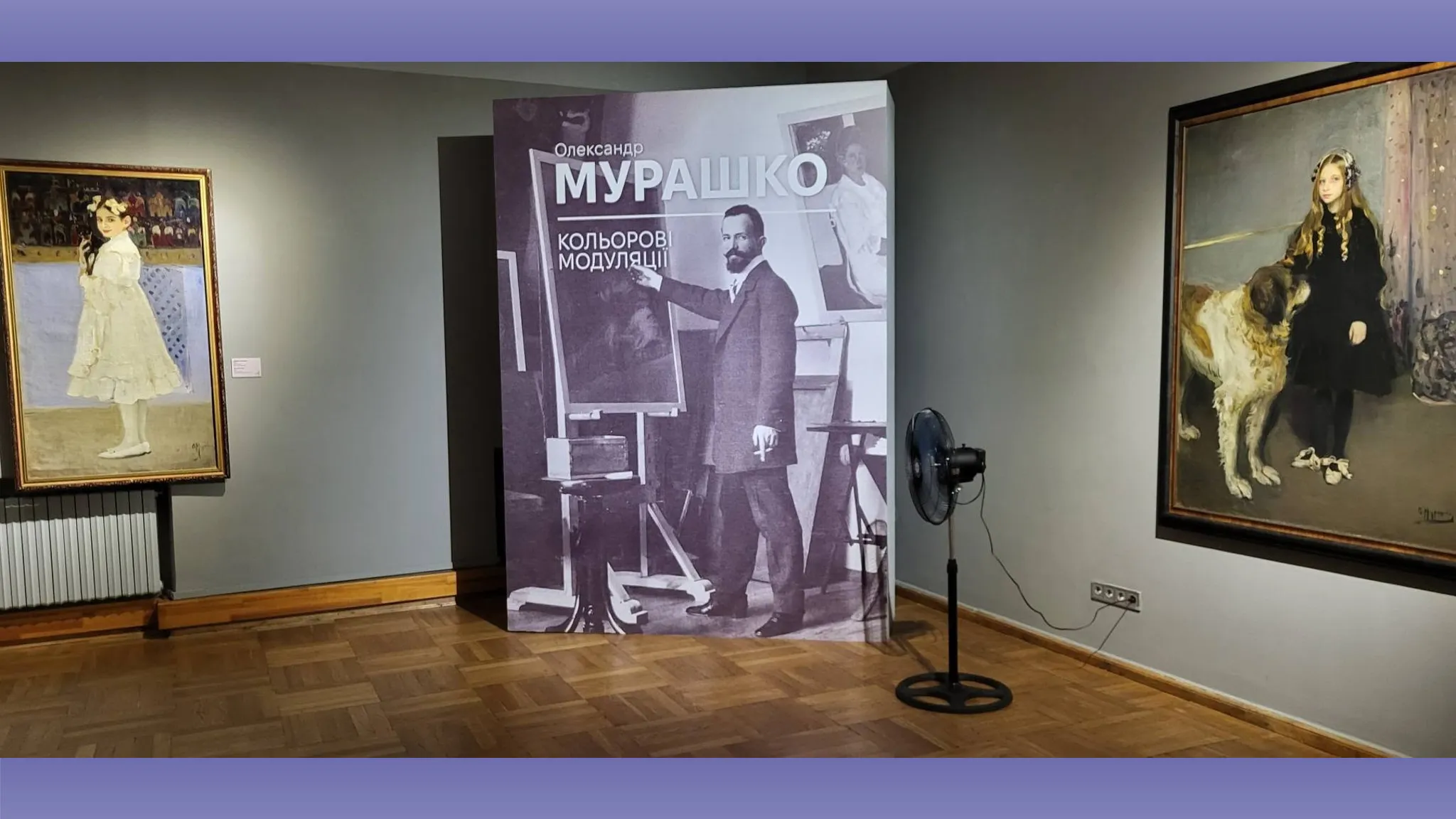
Collage by Olena Zelenina.
Standing in the halls of the National Museum in Lviv named after Andrey Sheptytsky at the exhibition "Oleksandr Murashko. Color Modulations," I caught myself looking at "Peasant Family" not as a textbook canvas, but as a living slice of time. My gaze lingered on the background, on the wall covered with… children’s drawings.
This is not a typical element of early 20th-century rural interior — in a peasant hut, the walls were usually decorated with icons, rushnyky (embroidered towels), or photographs of relatives. Therefore, these naive pictures are read almost as an "autograph" of the artist's presence.
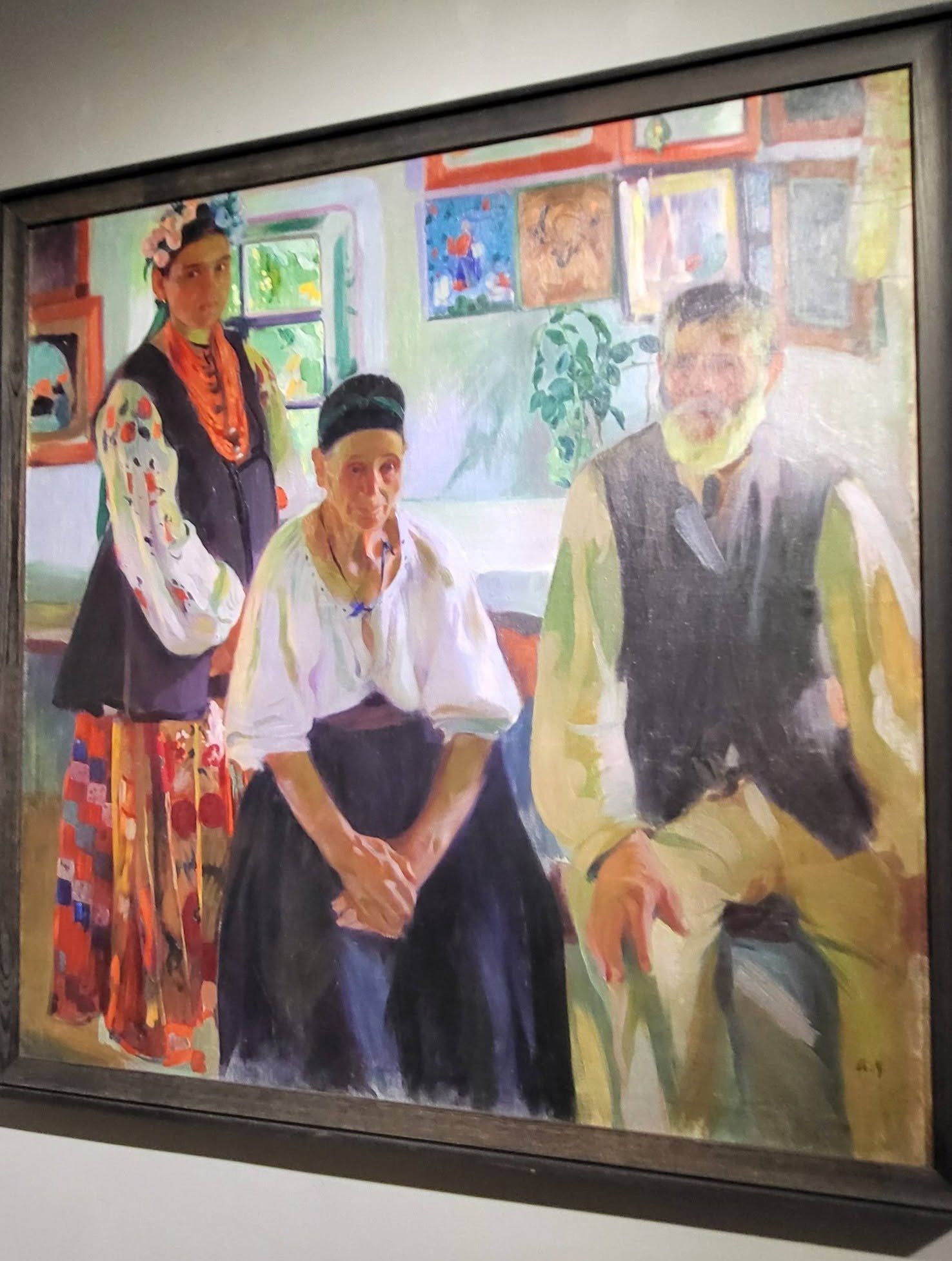
In the hut in the village of Luchky in the Poltava region, where the painting was created, these drawings on the wall suddenly become the key to understanding the relationship between the author and the subjects.
Perhaps Murashko, working there on plein-air sessions, did not just observe, but devoted time to local children, or even taught a young girl from this family to draw, leaving these "pieces of evidence" on the wall as a memory of shared moments?
I have not encountered art historians paying attention to such details!
This very detail transforms the hut from an ethnographic decoration into a space of living communication, where the artist was not an outside observer, but a close person who shared his vision of the world.
This humanity, this "quiet impressionism" is no coincidence. In the artist’s biography, one often looks for a trauma caused by being an orphan, yet his path and schooling are significantly more important.
Under the guidance of Ilya Repin, the artist creates his first fundamental canvas — his diploma work "Funeral of the Koshovyi." The painting was recognized as the best among student works, for which the artist received a gold medal and a grant with the prospect of continuing his education with the best painters of Germany, Italy, and France.
Cossack themes were one of Repin’s favorites, which influenced the choice of the plot; there is even an assumption that Mykhailo Starytsky posed for the painting.
It was this training that gave Murashko a deep connection with Slobozhanshchyna, and subsequent travels through Europe and life in Paris opened up the freedom of color to him. He masterfully combined the Ukrainian soul with European modernism, thanks to which the Poltava hut in his paintings acquired the scale of world classics.
His "Peasant Family" is a hymn to the light, which he masterfully "modulated" in his works.
But today, looking at this canvas, I feel a poignant anxiety because we know the finale. In 1919, at the turn of the eras, when the world around was going mad, Oleksandr Murashko was gone — a shot to the back of the head cut everything short.
This was not an "accidental death," it was the murder of an artist at the moment when he was most needed by his country.
Today, Ukraine is again going through a period where each of us is a target, and the life of a genius is just as fragile in the face of history.
We look at this cozy hut and see in it not only the past but also our own vulnerability.
When the world around becomes dark, Murashko's art — his ability to find light in the simplest things, in those same drawings on the wall or in the reflection of the sun on a rushnyk — helps to hold onto the ground beneath our feet.
It reminds us that even in the midst of great catastrophes, people strove to live, love, and teach children to see beauty. And this sense of kinship with the master across the centuries is what restores our faith in the meaning of our cause.
Note: Oleksandr Murashko (often referred to in international sources as Alexander Murashko).
More illustrations in the Ukrainian original. Read more in the Ukrainian edition....

Comments
Some more relevant news for now